Philadelphia Museum of Art
Philadelphia, PA
(215) 763-8100
http://www.philamuseum.org/
Alice Neel at the Philadelphia
Museum of Art
 Alice Neel's daring portraits of people and
places are among the most insightful images in 20th-century American art.
To celebrate the centennial of her birth, the Philadelphia Museum of Art
has organized Alice Neel, the first full-scale examination of her
inspiring and provocative life and work. Organized with the full cooperation
of the artist's family, this exhibition features 75 paintings and watercolors,
many of which have never been previously exhibited. Alice Neel has
opened at the Whitney Museum of American Art, New York City (through September
17, 2000) - see The Art
of Alice Neel (6/23/00) - and continues its national
tour at the Addison Gallery of American Art, Phillips Academy, Andover,
MA (October 7-December 31, 2000); the Philadelphia Museum of Art (February
18-April 15, 2001); and the Walker Art Center, Minneapolis (June 10-September
2, 2001). (left: Last Sickness, 1953, oil on canvas, 30 x
22 inches, Philadelphia Museum of Art, promised gift of Richard Neel and
Hartley S. Neel)
Alice Neel's daring portraits of people and
places are among the most insightful images in 20th-century American art.
To celebrate the centennial of her birth, the Philadelphia Museum of Art
has organized Alice Neel, the first full-scale examination of her
inspiring and provocative life and work. Organized with the full cooperation
of the artist's family, this exhibition features 75 paintings and watercolors,
many of which have never been previously exhibited. Alice Neel has
opened at the Whitney Museum of American Art, New York City (through September
17, 2000) - see The Art
of Alice Neel (6/23/00) - and continues its national
tour at the Addison Gallery of American Art, Phillips Academy, Andover,
MA (October 7-December 31, 2000); the Philadelphia Museum of Art (February
18-April 15, 2001); and the Walker Art Center, Minneapolis (June 10-September
2, 2001). (left: Last Sickness, 1953, oil on canvas, 30 x
22 inches, Philadelphia Museum of Art, promised gift of Richard Neel and
Hartley S. Neel)
Born in 1900 in Merion Square (now Gladwyne), near Philadelphia,
Alice Neel led a rich and complicated life, filled with friends, lovers,
family, fellow artists, and a strong sense of community and social activism.
A 1925 graduate of the Philadelphia School of Design for Women (now Moore
College of Art and Design),  Neel spent a year in Havana, then moved with her husband
to New York City, where she remained the rest of her life. In the 1930s,
her subjects included the colorful Greenwich Village poets and writers,
as well as friends and family. Neel's nude portraits of figures such as
her young daughter Isabetta and the bohemian icon Joe Gould are still audacious.
Employed by the W.P.A. during the Great Depression, Neel painted scenes
of the city street that reflect her trenchant concern for the dispossessed:
striking workers, impoverished families, and the homeless. Among the highlights
of Alice Neel are works from the Depression era that have never been exhibited
previously in a museum. (left: Linda Nochlin and Daisy, 1973,
oil on canvas, 55 1/2 x 44 inches, Museum of Fine Arts, Boston, Seth K.
Sweetser Fund)
Neel spent a year in Havana, then moved with her husband
to New York City, where she remained the rest of her life. In the 1930s,
her subjects included the colorful Greenwich Village poets and writers,
as well as friends and family. Neel's nude portraits of figures such as
her young daughter Isabetta and the bohemian icon Joe Gould are still audacious.
Employed by the W.P.A. during the Great Depression, Neel painted scenes
of the city street that reflect her trenchant concern for the dispossessed:
striking workers, impoverished families, and the homeless. Among the highlights
of Alice Neel are works from the Depression era that have never been exhibited
previously in a museum. (left: Linda Nochlin and Daisy, 1973,
oil on canvas, 55 1/2 x 44 inches, Museum of Fine Arts, Boston, Seth K.
Sweetser Fund)
During the postwar era, when the tide of the art world
had turned toward abstraction, Neel remained committed to the representation
of the human figure. She was steadfast in depicting the world around her
with compassion, acuity and freedom. Neel always displayed her empathy for
her subjects -- from her young sons or her dying mother to left-wing activists.
Portraits of her neighbors in Spanish Harlem employ humor and insight to
great effect -- both tender and unforgiving at once.
 In
the early 1960s Neel received her first recognition outside a small circle
of admirers. Her astounding emergence, late in life, corresponded with the
dawning of the women's movement and with the art world's reawakened interest
in the human figure. Neel's work of the next two decades reflects her increasing
celebrity. Her portraits of fellow artists -- including Andy Warhol, Frank
O'Hara, Robert Smithson, and Faith Ringgold -- document a professional world
in which Neel was suddenly a seemingly improbable star. It was during these
years that Neel perfected the style for which she is now best remembered:
large-scale portraits in the realist tradition of Thomas Eakins and Robert
Henri but newly inventive and unforgettably direct. (left: Thanksgiving,
1965, oil on canvas, 30 x 34 inches, Collection of Jonathan Monika Brand,
Portland Oregon)
In
the early 1960s Neel received her first recognition outside a small circle
of admirers. Her astounding emergence, late in life, corresponded with the
dawning of the women's movement and with the art world's reawakened interest
in the human figure. Neel's work of the next two decades reflects her increasing
celebrity. Her portraits of fellow artists -- including Andy Warhol, Frank
O'Hara, Robert Smithson, and Faith Ringgold -- document a professional world
in which Neel was suddenly a seemingly improbable star. It was during these
years that Neel perfected the style for which she is now best remembered:
large-scale portraits in the realist tradition of Thomas Eakins and Robert
Henri but newly inventive and unforgettably direct. (left: Thanksgiving,
1965, oil on canvas, 30 x 34 inches, Collection of Jonathan Monika Brand,
Portland Oregon)
A centennial salute from the artist's native city of Philadelphia,
whose culture and Museum she treasured, Alice Neel marks an opportune
moment for a first full appraisal. With the new century comes a reevaluation
of the modernist canon, which emphasized abstraction often at the expense
of adventurous figurative artists. The present-day resurgence of portraiture
as a vibrant field for both veteran and emerging artists confirms Alice
Neel's ongoing legacy.
 Alice
Neel will be accompanied by a fully illustrated
catalogue with essays and entries by Ann Temkin, The Muriel and Philip Berman
Curator of Modern and Contemporary Art at the Philadelphia Museum of Art,
Assistant Curator Susan Rosenberg, and Richard Flood, Chief Curator at the
Walker Art Center. Temkin discusses Neel's interconnection of life and art;
Rosenberg explores Neel's artistic roots in the 1930s; and Flood focuses
on the art-world portraits of the 1960s and '70s. The catalogue also includes
reminiscences by Neel's subjects, and the first detailed chronology of Neel's
life, richly illustrated with many never-before-published photographs.
(left: Robert Smithson, 1962, oil on canvas, 40 x 24 1/4 inches,
Private collection)
Alice
Neel will be accompanied by a fully illustrated
catalogue with essays and entries by Ann Temkin, The Muriel and Philip Berman
Curator of Modern and Contemporary Art at the Philadelphia Museum of Art,
Assistant Curator Susan Rosenberg, and Richard Flood, Chief Curator at the
Walker Art Center. Temkin discusses Neel's interconnection of life and art;
Rosenberg explores Neel's artistic roots in the 1930s; and Flood focuses
on the art-world portraits of the 1960s and '70s. The catalogue also includes
reminiscences by Neel's subjects, and the first detailed chronology of Neel's
life, richly illustrated with many never-before-published photographs.
(left: Robert Smithson, 1962, oil on canvas, 40 x 24 1/4 inches,
Private collection)
Alice Neel was organized by the Philadelphia Museum of
Art with the support of The William Penn Foundation, The Pew Charitable
Trusts, Agnes Gund and Daniel Shapiro, The Women's Committee of the Philadelphia
Museum of Art, and Alice's List, a consortium of individual donors. Corporate
sponsorship was provided by AT&T.
Read more about the Philadelphia
Museum of Art in Resource Library Magazine
Please click on thumbnail images bordered by a red line
to see enlargements.
For further biographical information on selected artists
cited above please see America's Distinguished
Artists, a national registry of historic artists.
This page was originally published in Resource
Library Magazine. Please see Resource Library's Overview section for
more information. rev. 4/30/11
Search Resource
Library for thousands of articles and essays on American art.
Copyright 2011 Traditional Fine Arts Organization, Inc., an Arizona nonprofit corporation. All rights
reserved.
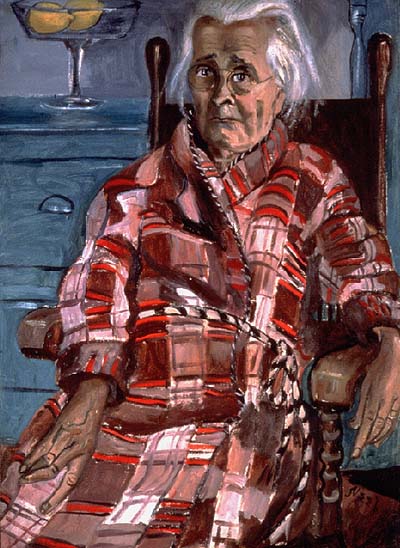 Alice Neel's daring portraits of people and
places are among the most insightful images in 20th-century American art.
To celebrate the centennial of her birth, the Philadelphia Museum of Art
has organized Alice Neel, the first full-scale examination of her
inspiring and provocative life and work. Organized with the full cooperation
of the artist's family, this exhibition features 75 paintings and watercolors,
many of which have never been previously exhibited. Alice Neel has
opened at the Whitney Museum of American Art, New York City (through September
17, 2000) - see The Art
of Alice Neel (6/23/00) - and continues its national
tour at the Addison Gallery of American Art, Phillips Academy, Andover,
MA (October 7-December 31, 2000); the Philadelphia Museum of Art (February
18-April 15, 2001); and the Walker Art Center, Minneapolis (June 10-September
2, 2001). (left: Last Sickness, 1953, oil on canvas, 30 x
22 inches, Philadelphia Museum of Art, promised gift of Richard Neel and
Hartley S. Neel)
Alice Neel's daring portraits of people and
places are among the most insightful images in 20th-century American art.
To celebrate the centennial of her birth, the Philadelphia Museum of Art
has organized Alice Neel, the first full-scale examination of her
inspiring and provocative life and work. Organized with the full cooperation
of the artist's family, this exhibition features 75 paintings and watercolors,
many of which have never been previously exhibited. Alice Neel has
opened at the Whitney Museum of American Art, New York City (through September
17, 2000) - see The Art
of Alice Neel (6/23/00) - and continues its national
tour at the Addison Gallery of American Art, Phillips Academy, Andover,
MA (October 7-December 31, 2000); the Philadelphia Museum of Art (February
18-April 15, 2001); and the Walker Art Center, Minneapolis (June 10-September
2, 2001). (left: Last Sickness, 1953, oil on canvas, 30 x
22 inches, Philadelphia Museum of Art, promised gift of Richard Neel and
Hartley S. Neel)

